
Sections of electrical cables, codes and capacity
What to know about the sections of electric cables, codes and relative capacities and amperes.
The electric cable is a component made up of one or more bundles of conductors (copper or aluminum), covered with a protective insulating material. The cores (conductors + insulation) are wrapped in a filler layer, which can be textile fibers, and in a sheath to protect against impacts.
The section of a power cable is expressed in mm2 (square millimeters) and indicates the surface made up of conductors inside.
The section and capacity of a cable is defined on the basis of the number of cores and their size.
Capacity of the electric cables (amperes)
When making an electrical system or choosing the power cable of an appliance, it is essential to correctly size the cable according to the capacity and consumption to avoid malfunctions. If you choose a cable that is too big, you waste resources, materials, space and above all money. If the section is too small, the cable tends to overheat, with a serious risk of short circuit.
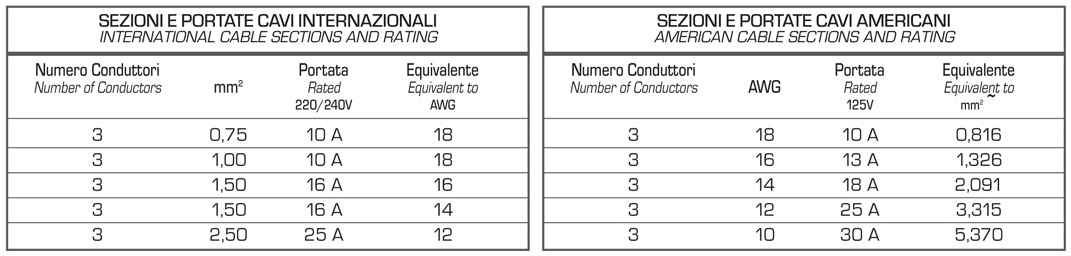
In the following tables we have reported the capacities and cross-sections of international and American electric cables and their equivalent.
Abbreviations for the designation of electrical cords
In addition to the section, another important characteristic of the cables is the designation code. This allows you to identify the type and materials of which the power supply codon is made and identify the most suitable for your application.
For outdoor environments, underwater or with high temperatures, for example, it is not possible to install the common electric cable that is usually used in homes for this reason there are various types.
In the article References for electrical cables you will find tables with all UL and CEI types and the related conditions of use.
Go to our electrical cables catalog to find the one that best suits your needs or contact us for more information.
 Previous news





 Contact us for more information



